























Algorithmic trading in India has moved from institutional desks to retail screens. Today, algorithmic trading India accounts for a majority of exchange activity, and a formal regulatory framework now governs retail participation. This guide covers the basics, the data, the rules and the risks.
What Is Algorithmic Trading?
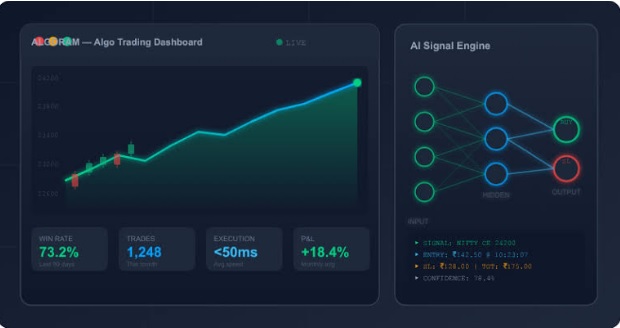
Algorithmic trading uses software to place orders based on pre-defined rules, such as price, volume or time. In algorithmic trading, rules can be written as code, built in no-code tools or run through a broker’s platform.
How Big Is Algorithmic Trading in India?
NSE data show algo trading at 54.0% of equity cash turnover in Q1 FY26, up from 49.2% in FY20, and 69% of equity derivatives turnover. Another summary of NSE’s Market Pulse puts the equity futures algo share at 69% in FY26 to date, up from 39% in FY15. A SEBI study reported by Reuters found that algos accounted for 97% of foreign investors’ and 96% of proprietary traders’ F&O profits in FY2024. The figures show how entrenched algorithmic trading India has become, particularly among institutions.
| The Regulatory Timeline | |
| Date | Milestone |
| 4 Feb 2025 | SEBI issues retail algo framework |
| 5 May 2025 | NSE implementation standards, 10 orders-per-second threshold |
| 30 Sep 2025 | Timeline extended; phased milestones |
| 5 Jan 2026 | Non-compliant brokers barred from onboarding new retail API clients |
| 1 Apr 2026 | Full framework mandatory for all brokers |
Under the framework, algo orders are tagged with a unique identifier, brokers are accountable, and providers empanel with exchanges. Algorithmic trading India for retail users therefore runs through broker-supervised access.
Algorithmic Trading Platforms
Retail traders can access algorithmic trading through different types of platforms and services. The right choice depends on strategy-building tools, broker integration, automation options and regulatory compliance.
| Comparison factor | SMC Trade Online | Other algo-trading platforms |
| Platform type | Verify the specific trading and automation services offered | May include broker platforms, no-code strategy builders and coding-based systems |
| Strategy creation | Check available tools and customisation options | May support visual rules, predefined strategies or code-based development |
| Broker integration | Confirm supported brokers and account requirements | Depends on the platform and its integrations |
| Order execution | Verify supported order types and automation capabilities | May offer automated or semi-automated execution |
| Regulatory requirements | Confirm the applicable broker and exchange requirements | Requirements depend on the execution arrangement and applicable regulations |
Common Strategies
Algorithmic trading strategies differ according to the trader’s objectives, market conditions and risk tolerance.
- Execution algos: split large orders to reduce market impact.
- Trend and momentum rules: enter and exit on indicator triggers.
- Arbitrage and spreads: exploit price gaps between instruments.
- Scheduled investing: automate regular purchases.
Benefits and Limits
Benefits include speed, consistency and removal of manual hesitation. Limits include coding or setup errors, overfitted backtests, data issues and technology failures. Algorithmic trading in India does not remove market risk, and it does not predict prices.
A Practical Checklist
Before using an algorithmic trading platform, evaluate its regulatory setup, test its strategies and establish clear risk limits. These steps can help you identify operational issues and understand how a strategy behaves before committing significant capital.
- Choose a broker operating within the SEBI framework.
- Backtest and paper trade.
- Start with small quantities.
- Set position, loss and order-size limits.
- Monitor live and keep logs.
Special Sessions and Automation
Automation questions arise during festive sessions too. Muhurat trading means a special one-hour session held by NSE and BSE on Diwali, with normal settlement obligations. In 2026, it falls on Sunday, 8 November, with timings to be notified. Past sessions have produced small moves: the Nifty rose 0.10% and the Sensex 0.07% in 2025, and the Sensex closed 0.04% lower in 2016.
Understanding what Muhurat trading means helps you decide whether to run automation in a short, lower-liquidity window at all. Check with your broker whether API access is enabled for special sessions.
Choosing Access
Brokers differ in what they offer. SMC Global Securities, established in 1990, describes semi and fully algo options in third-party profiles and an API with REST and WebSocket support. Confirm current details directly.
In Conclusion, algorithmic trading in India is large, regulated and increasingly accessible. Know the framework, start small, and treat automation as an execution tool, not a source of guaranteed returns.